Climate Matters•June 3, 2026•Reuse this content
2026 World Cup: Climate Change Boosts Performance-Impairing Heat at Nearly Every Match
KEY FACTS
Warming caused by climate change could impair player performance and affect match strategy at the 2026 World Cup.
A new Climate Central analysis shows that climate change is boosting the likelihood of performance-impairing heat during most scheduled World Cup matches (97 of 104).
Nearly half of the matches (49) have at least a 50% likelihood of experiencing heat that can impair performance. In 26 of those matches, climate change increases the likelihood by at least 10 percentage points.
Among all matches, climate change boosts the odds of performance-impairing heat most during the June 26 match in Guadalajara between Uruguay and Spain. The 70% chance of such heat during that match is 37 percentage points higher due to climate change.
Explore Climate Central’s information hub, Off Your Game: How Climate Change Could Slow Down the 2026 World Cup, to find climate data and stories for every stadium, match, and team. Check in throughout the World Cup for regular heat updates.
VISUALS
Loading visual assets...
LEARN MORE
DATA EXPLORER
![CM: 2026 World Cup: Climate Change Boosts Performance-Impairing Heat at Nearly Every Match [EMBARGO VERSION]](https://images.ctfassets.net/cxgxgstp8r5d/7Pehzx08dmJiFG3sv16h4/dcb5b1796fb30b953fb3190fb8072e32/Screenshot_2026-06-03_at_11.02.04_AM.png?w=3840&q=85&fm=webp)
FULL REPORT
The World Cup tournament is heating up
On June 11, the men’s 2026 World Cup will kick off with an opening ceremony in Mexico City. During the following six weeks, soccer fans will watch 48 teams from around the world compete for the coveted prize. Teams will compete in 104 matches across 16 cities in the U.S., Mexico, and Canada.
Every soccer fan knows there’s strong national pride intertwined with earning the World Cup. That brings pressure for players to perform their best and bring home a trophy.
But planet-warming carbon pollution brings additional challenges for the qualifiers. During the 2026 World Cup, we’ll likely see the real-time consequences of a warming world on this sport — heat that puts the health and performance of players at risk.
Heat affects player performance, match strategy
Research suggests that temperatures above 28°C (82.4°F) can affect soccer players’ performance — especially how fast, far, or frequently they run during a match. This can influence a team’s overall match strategy and style of play.
Ultimately, it could be harder for players to reach their peak performance during a match because of hotter temperatures. And teams with styles of play that rely on speed and repeated sprinting could face a disadvantage.
Climate change boosts odds of performance-impairing heat
Climate Central used historical data to analyze the likelihood that daily temperatures will exceed the performance-impairing threshold (28°C or 82.4°F) during the 104 World Cup matches. We compared the odds in both our current carbon-polluted world and a world without carbon pollution to understand the influence of climate change on the likelihood of performance-impairing heat.
Warming caused by climate change is boosting the odds of performance-impairing heat during most scheduled World Cup matches (97 of 104), by about 8 percentage points on average
Nearly half of the World Cup matches (49) have at least a 50% likelihood of experiencing heat that can impair performance. In 26 of those matches, climate change is increasing the likelihood by at least 10 percentage points.
Among all matches, climate change boosts the odds of performance-impairing heat most during the June 26 match in Guadalajara, between Uruguay and Spain. The 70% chance of such heat during this match is 37 percentage points higher due to climate change.
We don’t yet know which two teams will make it to the final match, scheduled for July 19 at MetLife Stadium in New Jersey, called New York New Jersey Stadium by FIFA. But we do know that whichever teams advance will face a 47% likelihood of performance-impairing heat — odds that are about 17 percentage points higher because of climate change.
Following heat stories during the World Cup
As the tournament unfolds, you can find weekly forecasts alongside climate data and stories for every stadium, match, and team in Climate Central’s information hub, Off Your Game: How Climate Change Could Slow Down the 2026 World Cup.
Check in regularly and sign up for email alerts so you never miss an important update.
Adapting the sport to a warming world
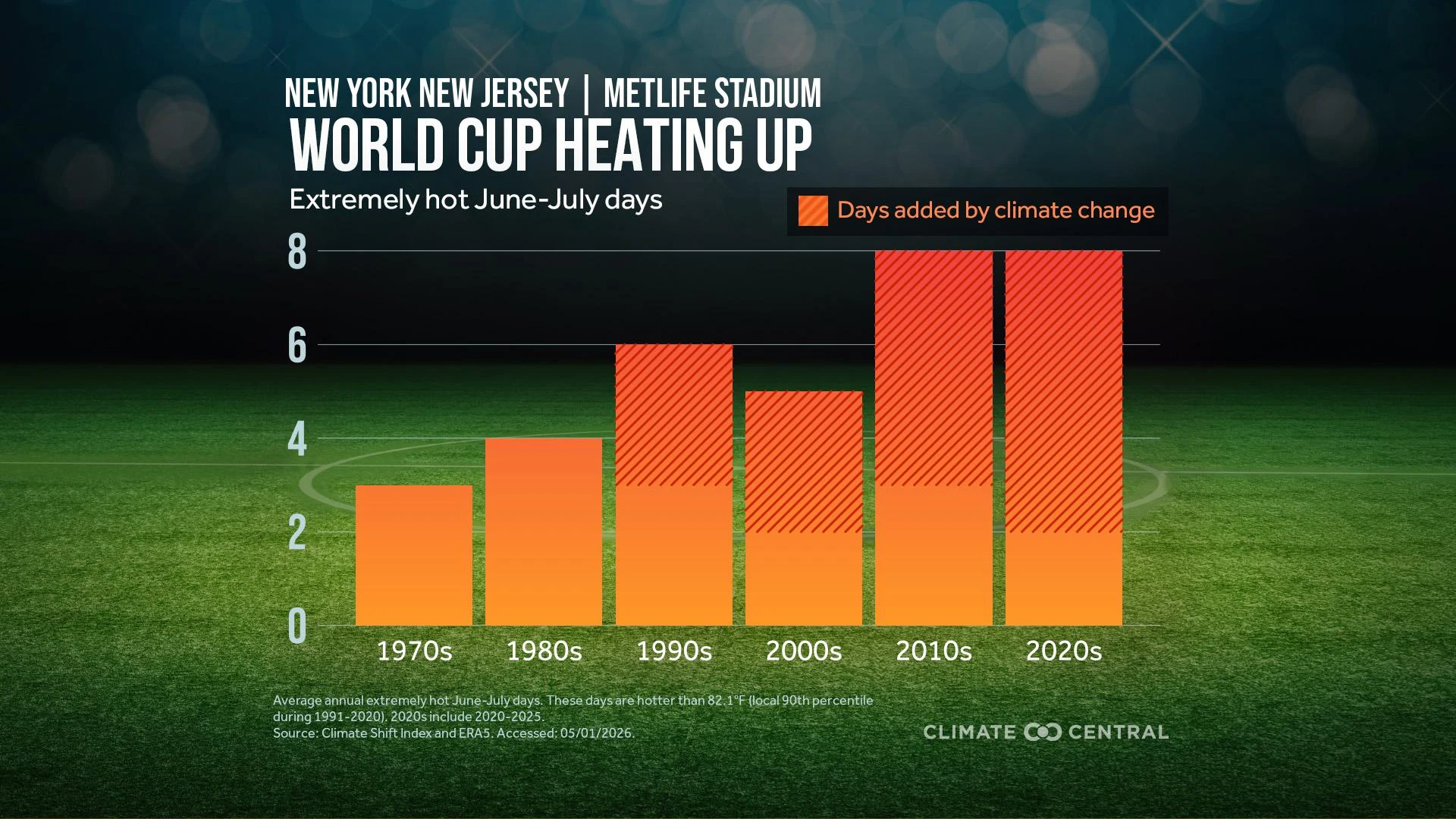
Extremely hot June-July days are on the rise at all but two of the 2026 World Cup stadiums, according to another recent Climate Central analysis.
Extreme heat can affect more than performance — it can pose a serious health risk, especially when combined with high humidity.
To keep players, fans, and staff safe, World Cup organizers are adapting to the rising heat risks with more evening matches in hotter cities and mandatory hydration breaks at all 104 matches. Matches may be postponed if the web-bulb globe temperature (a measurement of humid heat) hits 32°C (89.6°F) to minimize risks of heat stress.
But most stadiums are open-air, leaving players and millions of fans exposed to peak summer heat. Only three stadiums are fully climate-controlled (Atlanta, Dallas, and Houston).
RELATED RESOURCES
![CM: 2026 World Cup: Climate Change Boosts Performance-Impairing Heat at Nearly Every Match [EMBARGO VERSION]](https://images.ctfassets.net/cxgxgstp8r5d/7Pehzx08dmJiFG3sv16h4/dcb5b1796fb30b953fb3190fb8072e32/Screenshot_2026-06-03_at_11.02.04_AM.png?w=2048&q=85&fm=webp)
CONTACT EXPERTS
To request an interview with a Climate Central expert about this analysis, please contact Abbie Veitch, aveitch@climatecentral.org.
METHODOLOGY
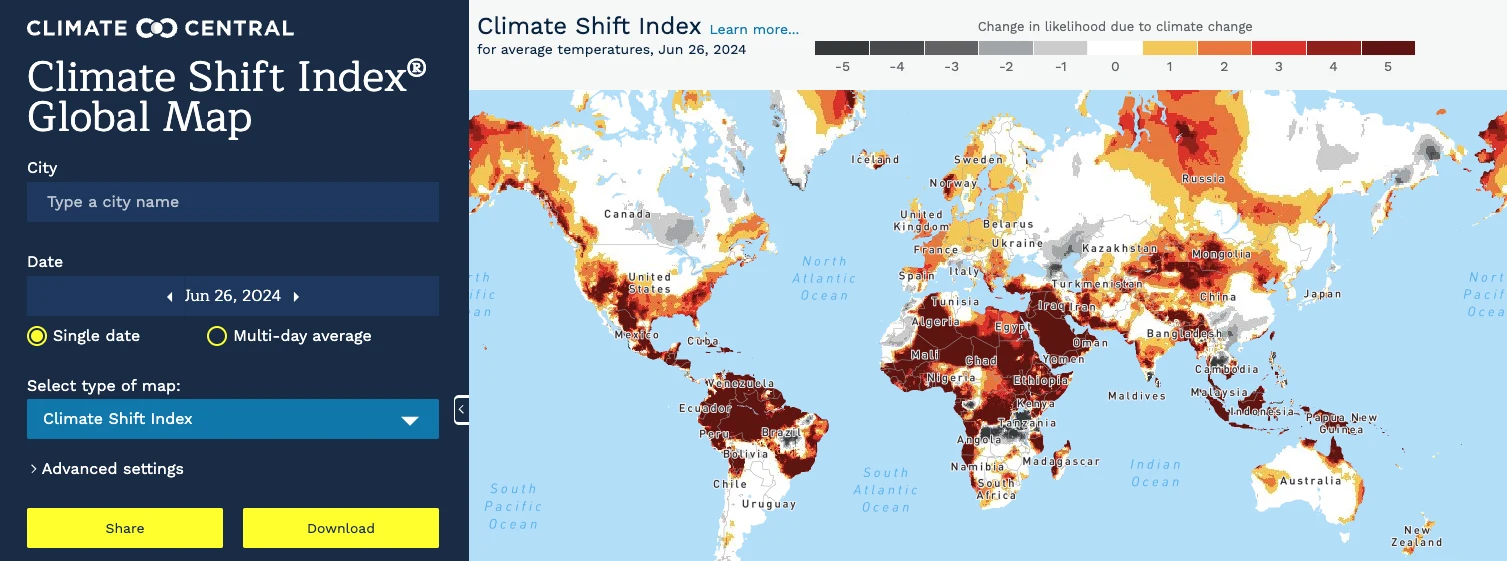
A study by Chmura et al. (2017) examined how soccer player performance was affected by temperature during the 2014 World Cup in Brazil, finding declines in key performance metrics above 28°C (82.4°F). We use this threshold to assess the likelihood of conditions associated with performance impacts during 2026 World Cup matches, using data from Climate Central’s Climate Shift Index (CSI) system.
For each soccer match, we identified the nearest grid cell (0.25° resolution, based on ERA5) and matched the date to the closest available day in the CSI system, which represents a 30-day climatological window centered on that date. We then computed the probability that daily maximum temperature exceeds this threshold under two scenarios: a counterfactual climate without climate change (0°C of warming) and the current climate (~1.3°C of warming above pre-industrial levels).
Here, we present the likelihood that maximum daily temperatures for each of the 104 scheduled matches will exceed the performance-impairing threshold (28°C or 82.4°F) in our current climate and how many percentage points are due to climate change. Though some matches are scheduled to start after daily temperatures will likely peak, heat can linger into the evening.
The CSI framework combines observational data and climate model simulations to estimate these probabilities, capturing both real-world temperature patterns and modeled climate change.
Results for the current (2026) climate represent the likelihood of performance-impairing temperatures based on climate models and may differ from actual 2026 match-day conditions.
Climate Matters © 2026 by Climate Central is licensed under CC BY 4.0
This license grants permission to use, distribute, and reproduce all text, graphics, and multimedia content published on this page in any medium, provided that Climate Central is credited per the CC BY 4.0 license.
Permission to use data and other materials published on this page is granted for non-commercial uses, commercial news purposes, and educational purposes as governed by Climate Central's Terms of Use.